

A couple of weeks ago I did a poll on Instagram.
It was a simple question.
Who would you rather punch in the face: Pedro Sánchez or Donald Trump?
I was expecting Trump to win by a large margin. But in the end – contrary to my expectations – it was very close.
I guess a lot of Spanish people hate Pedro Sánchez.
My reason for the poll was that Sánchez was having his 15 minutes of international fame after a public spat with Donald Trump. The issue was the use of US bases in Spain for attacks on Iran.
Spain’s “No a la guerra” was among the top stories for a few days. And from what I hear, standing up to Trump gained Sánchez some fans in the US.
I don’t have much to say about the larger context of the Iran war and geopolitics in the Strait of Hormuz. But I can say something about Pedro Sánchez. Because I hate the guy, too.
In fact, I’ve been hating Pedro Sánchez for so long I could barely remember why.
So let’s do a little refresher on the last several years of Spanish politics.
Sánchez’s Vote of No Confidence
Pedro Sánchez came to power in 2018, after staging a vote of no confidence against then-President Mariano Rajoy.
This was after a few judicial sentences came down from Caso Gürtel – a corruption case which had been dragging on for years, and which implicated important members of Rajoy’s party.
Right-wingers spent the next few years calling the PSOE (the Socialist Workers’ Party of Spain) los golpistas, as if this were a coup d’état and completely illegitimate.

That’s a big exaggeration. Parliamentary procedure was followed. No-confidence votes are risky, and this one happened to work out, for Sánchez.
But the fact is he made it into office without being elected President of the Government.
Side note: Here in Spain, the title President of the Government basically refers to a Prime Minister. I usually use the term President because officially, he’s not the Prime Minister. But we shouldn’t understand “President” in the sense of an executive branch presidency like the US has.
Further side note: In general, when discussing politics, I’m writing as a man on the street. I’m a hard-working Spanish American trying to get by, and maintain some personal dignity in a complicated world. So if you’re thinking that I don’t seem to be repeating partisan slogans or pretending to be an expert on fiscal policy, you’re right. I’m just some guy, with an opinion, and a podcast.
Anyway, the newly un-elected President was able to govern by coalition with the far left, and some of the separatist and regional parties, notably the Catalan Independence parties.
Cozying up to Catalan Independence Parties
And that, when I review the history, is the original reason I despise Pedro Sánchez.
Back in 2017 and 2018, if I had been able to vote, I would have been a single-issue voter. And the issue would have been the unity of Spain.
The Constitution is clear on this. Article 2 mentions “la indisoluble unidad de la Nación española, patria común e indivisible de todos los españoles.”
What that amounts to is basically that Spain is one country, unified and indivisible: a homeland for all Spaniards.
It must be said that I wasn’t a Spaniard myself at the time. I was an American living in Madrid, and I formed my opinions on the indivisible unity of Spain down there.

Soon after the unconstitutional and illegal Catalan “independence referendum”, I found myself living in Barcelona. At first, I thought that living among the Catalans might make me more sympathetic to their cause.
It didn’t. In fact, over seven (almost eight) years of life in Catalonia, nobody has made any effort to charm me, and nobody has given me a good explanation as to why I should change my mind about Spanish unity.
But I don’t want to write a whole article about Catalan independence.
I just value constitutional order, and I didn’t like the fact that Sánchez’s first act in office was to form a coalition with the very people who had just tried to subvert the Constitution.
Later, after losing some of his seats in Parliament in the 2023 election, he further placated the Catalans with a law declaring amnesty for anything independence- or referendum-related.
Several leaders of the independence movement were pardoned and let out of prison. Fearless Catalan leader Carles Puigdemont is still hiding out, up in Belgium. I guess his crimes aren’t pardonable.
Moving Franco’s Tomb
But back to Pedro Sánchez. One of the government’s first big acts with Sánchez as President was to move Franco out of Valle de los Caídos.
Old-timey right-wingers didn’t like this much.
In case you’re not up to speed, Francisco Franco won the Civil War in 1939 and soon after, started building himself a large basilica outside Madrid.
He was buried there after his death in 1975. The plaza outside the basilica is modeled on Saint Peter’s Square in the Vatican, and the whole thing is topped by a 150-meter-high cross, meaning you can see it from a long way off.
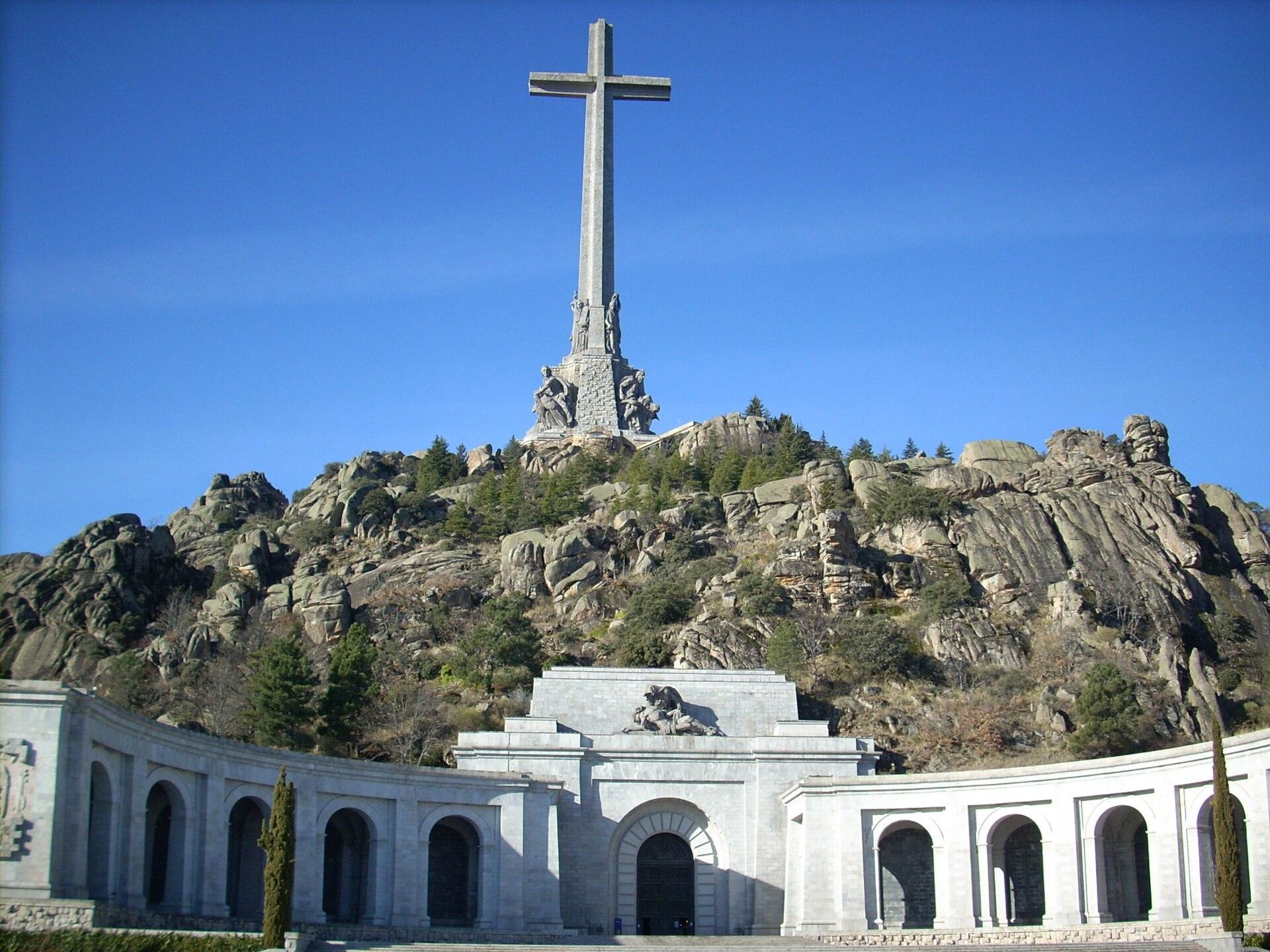
Foreign journalists are (apparently) required by international law to refer to the whole thing as pharaonic, a reference to the Egyptian pharaohs entombed in their pyramids.
The Historical Memory laws had for some time been allowing people to dig up Civil-War-era mass graves, and a lot of old fascist monuments had been removed, too. Street names changed, things like that.
I personally don’t have much of an opinion about it. They moved Franco to the cemetery at Mingorrubio, which is a lot closer to Madrid. (Just a short walk from El Pardo, actually.)
I don’t think that was the government’s original intention, but the Franco family also had their say in the whole thing, and one of the offers on the table was to put him in the crypt at the Almudena Cathedral in Madrid… which hardly would have been better.
Pedro Sánchez’s Unconstitutional Covid Lockdowns
I had very little respect for Pedro Sánchez going into the Covid-19 pandemic in March 2020. And I lost that respect when he declared the State of Alarm.
Believe it or not, I don’t own a TV. I read the news online, and up to that point I’d never seen Sánchez speak.
But it seemed like a historical moment, so I watched his speech on my laptop. He said something about how true bravery consisted in washing your hands and staying at home.
I wanted to puke.
He seemed like wimp, and totally out of his depth.
I was hoping for strong leadership I could trust, and Pedro Sánchez wasn’t it.
Anyway, we weren’t allowed to go outside for months. Office workers loved it, because they could sit at home and watch Netflix, hop on a meeting now and then, and earn a full salary despite barely working.
I hated the whole thing.
Eventually the courts declared the lockdowns to be an unconstitutional violation of basic rights – specifically, the Constitutional right to freedom of movement.
In theory, some of the people who were fined for walking around the block were able to get their money back on appeal.
But I’d assume I’m not the only person who lost a lot of trust in the Spanish government as a result of the (mis)management of the Covid-19 situation.
Kowtowing to the European Union
This is a larger problem, which goes beyond Pedro Sánchez.
But it seems like European governments are, at this point, forced to defer to the European Union on a whole lot of things. It’s not really clear who’s in charge, if anyone.
Here’s a small example: Daylight Saving Time.
I detest Daylight Saving Time. I hate it with every fiber of my being. And apparently, so do a lot of other people.
Pedro Sánchez has said that he wants to get rid of it. But – oops! – he can’t, because he needs a consensus from every country in the EU to do so.
I have a whole article about the Daylight Saving Debacle (well, two, actually). It’s stupid. But there’s nothing to be done. We’re changing the clocks in a couple of weeks, and (despite repeated government promises to the contrary) there’s no end in sight. Because Sánchez can’t do anything without a 27-country consensus.
Another example is more serious: I recently read that Barcelona’s government has suggested they’d like to stop foreign hedge funds from buying up flats. This would help with the housing crisis, but – oops! – turns out we can’t do it. Because one of the fundamental freedoms of the EU is the “free movement of capital”.
Apparently, that means that Dutch companies can trade our national real estate like Pokemon cards, and there’s nothing we lowly Spaniards can do about it.
The EU’s bureaucratic inefficiency
When the British voted for Brexit back in 2016, I was very critical of their decision.
But 10 years later, I also have the feeling I’m being taxed into oblivion by a government that doesn’t represent my interests. A government which, instead, defers on many questions to a bunch of Brussels bureaucrats.
It’s possible that I’m wrong, and that the EU does all sorts of brilliant things for everyone. But in that case they’re not doing a very good job of keeping us informed about what, exactly, those brilliant things are.
As it is, I feel like Sánchez and his cronies are delighted to pass off blame for certain problems to the EU, which bogs us all down in even more bureaucracy, while nothing gets done.
I’ve written about this before: European efficiency suffers, and it’s hard for businesses (or countries) to compete when they have to ask permission from seven layers of bureaucrats in order to try anything new.
Which brings us to our next point…
Sánchez and the Socialists Don’t Support Business
These days I have a small online business.
Trying to run such a thing under a socialist government is not much fun.
The tax people are always up my ass about one thing or another. Apparently, their inspectors get paid just for opening investigations into people like me. They’re incentivised to harass small business.
Also, they’ve raised my Social Security payments quite a bit the last few years – I’ve even had to pay for a retroactive rate hike, years after the fact.
We could debate the definition of socialism – this certainly isn’t what Karl Marx had in mind – but what I mean in Spain’s case is basically that taxes are high, and there’s a large welfare state.

The Socialist party, who run things, don’t talk much about small businesses and the need to support them. They’re more into inventing new government subsidies, and raising taxes, and creating dependence on the state.
On the other hand, they’ve redefined the different types of work contracts so that seasonal work counts as “indefinite” – people can go on unemployment benefits for months every year and still be counted as “employed”.
I’m not the first person who’s pointing out that this sounds like an attempt to fake the unemployment numbers, so they can claim they’re improving the economy.
And then there are the laws that make it hard (and expensive) to fire people, which sounds great from a workers’ rights perspective. The unintended consequence, though, is that some people just want to sue the company for a larger severance package than rather do their jobs. Why should you work, if you can’t be fired?
(That sort of thing happens with some frequency to my wife Morena, who manages a team at a large company. I wrote about it at length in my article on Working in Spain.)
The Housing (and Cost-of-Living) Crisis
I have a whole article about the Spanish housing crisis, and it’s a BIG topic.
Suffice it to say that the government tried their best to solve it, and only made things worse. The new housing law passed in 2023 has created a huge drop in the number of flats for rent.
Less supply, plus more demand (largely due to mass migration) makes a terrible system that just exploits people who need a place to sleep.
Meanwhile, it takes years to get all the permits to build anything new. It’s a shitshow.
Also, it’s obvious to everyone that prices for basic goods are double what they were when Sánchez took office. And most people’s salaries haven’t doubled to compensate.
When Socialist-party fanboys and their coalition partners further to the left complain about the rise of the far right, I always want to point out that if the leftists were able to make society work better for regular people, the far right wouldn’t be rising. But it is rising – and that tells you something.
Recently, Spain’s macroeconomic data have been impressing journalists at The Economist – who say we’re doing just fine. But that doesn’t seem to translate into real improvements for “man on the street” types like myself.
Sex and Corruption Scandals
Sánchez’s government loves to wrap themselves in the purple flag of international feminism.
In practice, there’s been a recent wave of PSOE party members resigning due to allegations of sexual misconduct. Nothing directly touching Sánchez, but it is his party and his most ardent supporters.
The last couple of years have also been clouded by accusations of corruption. I have not one but two articles on here about Caso Koldo, the main case, which is a bit long and involved.
Here’s my first Caso Koldo article, and here’s the aptly-named Revenge of Caso Koldo.
The short version is that some of Sánchez’s best friends were (allegedly) selling surgical masks to the government during the pandemic and pocketing the proceeds. This was done through anonymous shell companies – exactly how you’d do it if you had nothing to hide.
That case is going slowly through the courts, just like Gürtel back in the day.
(There’s actually a cameo in the “Revenge of Caso Koldo” article from Delcy Rodríguez, now President of Venezuela. She was tangentially involved in some of the PSOE’s shady dealings a few years ago.)
Also, in semi-related news, José Luis Ábalos – Sanchez’s right-hand man for years – was renting luxury flats for escorts, and then getting them jobs in public companies. He’d text his homies comparing the “services” received from various girls he’d hired online. That’s in my article about sex scandals.
Keep in mind, there’s nothing illegal about hiring prostitutes in Spain. But it doesn’t come across as very feminist, when some of your closest friends are puteros.
(I should add, here, that one of the government’s promises on coming to power was that they would prohibit prostitution. But they haven’t done it. Thankfully, though, men can now identify as women on their national ID cards. Feminism!)
Pedro Sánchez and the War in Iran
People who haven’t been following Spanish politics for very long don’t know this, but Pedro Sánchez’s “No a la guerra” is a callback to 2004, when Spain pulled out of the Iraq War.
If you didn’t know that Spain was involved in Iraq to begin with, I don’t blame you. But then-President José María Aznar wanted to cuddle up to the US and Great Britain, and sent out 1300 Spanish troops to join a very unpopular conflict.
They didn’t see much combat, and didn’t stay long.

On March 11th, 2004, radical Islamists blew up 4 trains in and around Madrid’s Atocha Station. A total of 193 people were killed, making it by far the deadliest terror attack in Spanish history.
This was just three days before a national election.
Long story short, the Socialist Party won that election and pulled Spain out of Iraq. “No a la guerra” was the popular thing for a couple of years around that time.
Pedro Sánchez could be gone from the Spanish government soon, but he’s still a youngish guy. It seems like his spats with Trump (and with Israel, etc) could be an attempt to position himself as an international leftist symbol.
Maybe his retirement plan is to became a sort of a smarmy, polo-shirted Che Guevara for Gen Z to make TikTok dances about.
In the meantime, he doesn’t want the US using their bases in Spain for refuelling planes on the way to Iran. He also doesn’t want to invest 5% of the GDP in defense, as agreed on by other NATO countries in 2025.
The whole European Union, but Sánchez in particular, seem content to sit on the sidelines wringing their hands while other people do geopolitics.
From the man who once said that true heroism consists of washing your hands and staying at home, I would expect nothing more.
I’m Voting in the Next Spanish Election
The other day I got a letter from the Electoral Census, saying I’m officially registered to vote in Spain.
Now that I’m finally a citizen, I get to go to the polls and choose our new government.
Pedro Sánchez has repeatedly said he’s going to ride out his current mandate. In that case, the next national election would be in the summer of 2027.
But in the parliamentary system we have, he could call elections earlier if he had to. Or the opposition could hold a vote of no confidence, just like Sánchez did back in 2018.
Either way, I’m not really looking forward to voting, because I don’t like any of the political parties in Spain. And we have several. For years, the PSOE and the PP dominated Spanish politics, but during the economic crisis there was a splintering.
New parties were created left, right and center. The leftist ones split and then split again. The far right rose, and fell, and now seems to be rising again.
Over here in my working-class neighborhood in Barcelona, I don’t really support any of these ideologies. In fact, the government and media establishment has done quite a bit over the last 10+ years to lose my trust.
And I’m sure I’m not the only one.
Pedro Sánchez and the Future of Spanish Politics
There are still some ride-or-die Socialists who will vote for the PSOE no matter what.
But as my poll at the beginning of this article suggests, Pedro Sánchez is also very unpopular among large swathes of the Spanish population.
It’s broadly assumed that Sánchez and/or his party will be voted out of office in the 2027 election, and that the next government will be a coalition of the PP and Vox.
But a lot can happen in the coming year to upend our current assumptions.
Either way, Sánchez’s 15 minutes of fame will probably be over soon.
I resisted writing this article for a full week, because I didn’t think it was worth talking about that empty suit at all. But here we are, talking about him.
There’s a quote I like, by the naturalist John Muir. It goes:
“When we try to pick out anything by itself, we find it hitched to everything else in the Universe.”
– John Muir
That’s how I feel about reading the headlines most days. Because today’s relevant quote – “No a la guerra”, in this case – turns out to be connected to the Iraq war and the Atocha bombings more than 20 years ago.
And those US military bases are connected to Franco, whose story goes back to the Spanish-American War of 1898. And if you pull that thread, you end up at the Reconquista, and the Muslim conquest.
Maybe all the way back in Rome.
Yours,
Daniel AKA Mr Chorizo.
P.S. This article is sponsored by Karen, out in the US, who donated some money to the podcast and then innocently asked me about US-Spanish relations and my opinion the current “pissing match” – her words – between Donald Trump and Pedro Sánchez. I was going to avoid the whole topic and stick to the lives of Saints or something similar, but if you send me money I’ll write about almost any topic you want. Donate right there at the link, or by using the Donate! button in the top right corner. Thanks!

0 comments