

A few weeks ago, for my birthday, Morena and I walked across Collserola.
That’s the big natural park outside Barcelona.
We took the Way of Saint James – you might know it as the Camino de Santiago – across the hills from the outskirts of Barcelona all the way to Sant Cugat, where we had lunch and then caught the train back.
It’s a nice walk. About 12 kilometers, with the uphill at the beginning, so you get it out of the way before walking downhill for the last couple of hours, into Sant Cugat.
The Collserola area is known (among other things) for its wild boars, which sometimes come down to feast on garbage in neighborhoods like Sarrià.
We’ve seen boars there a couple of times, but this time we didn’t see any. We just had a nice walk.
Suddenly, a couple of days later, the wild boars of Collserola took over the Spanish news – there had been an outbreak of the peste porcina africana, also known as la Pepa (because of the PPA acronym).
About the African swine fever
In English, this is (apparently) the African swine fever – a virus that’s transmitted among pigs and boars, and that kills almost all that come down with it.
This swine fever outbreak happened in an area called Bellaterra, which is just outside Sant Cugat.
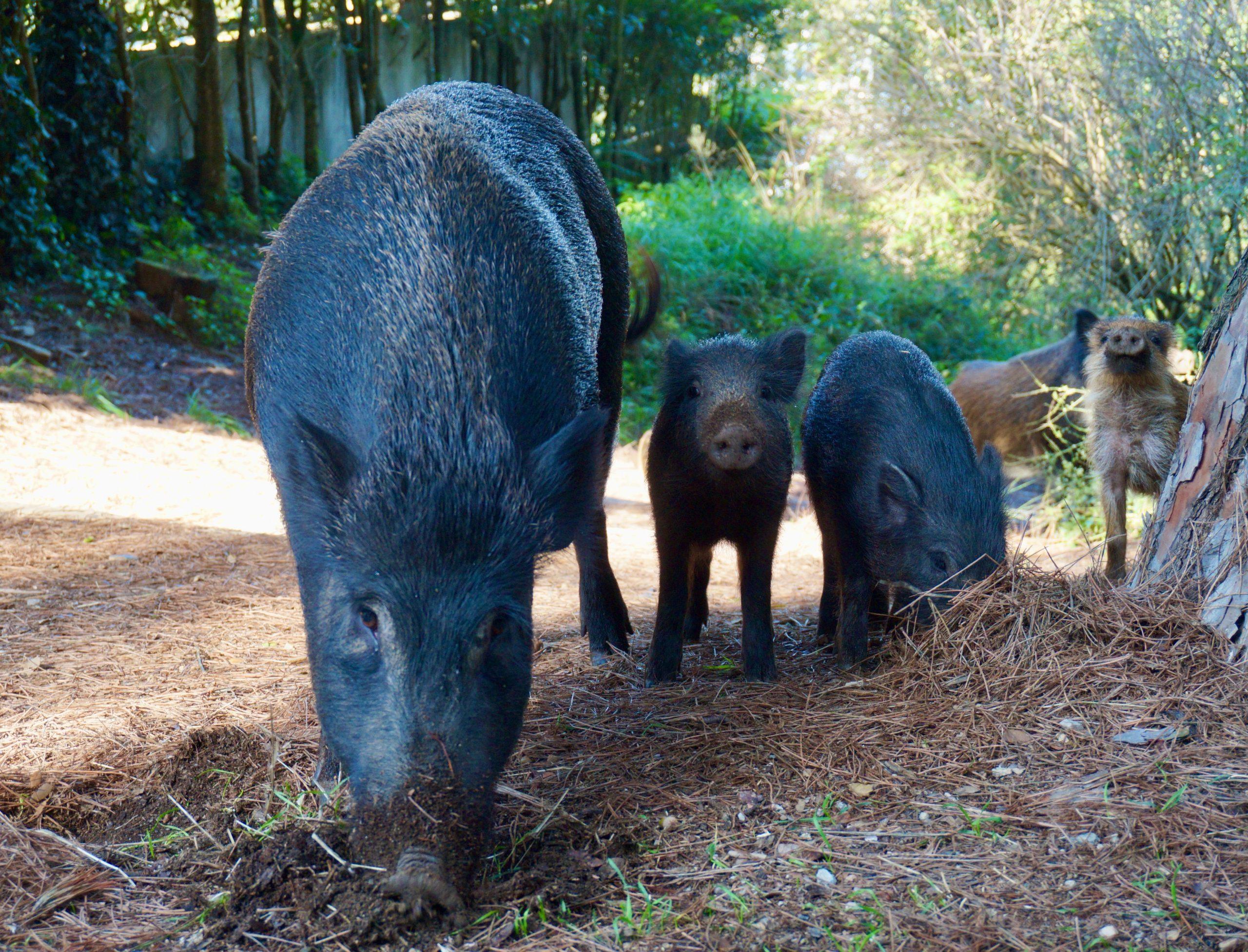
A few boars were found dead, the people who do boar autopsies determined it was the deadly swine fever, and panic ensued. Within hours, the authorities had closed Collserola and were trying to convince people “not to visit nature” anywhere in a 20-km radius from the site of the outbreak.
Of course, Collserola is also populated in some places, as is the area around it, so keeping people completely out of nature is impossible.
But in theory, activities like hiking and biking were – and are – prohibited. Picnickers may be fined.
There’s a Spanish proverb about this: no se pueden poner puertas al campo. It refers to the futility of trying to prohibit things that everyone’s going to do anyway.
But “poner puertas al campo” is exactly what the government is trying to do.
Anything to contain the swine fever.
Swine fever outbreak in Barcelona
Pork is a big industry here in Spain, and it’s also culturally important. Just look at the name of Spain’s premier expat lifestyle blog, for example – it’s called The Chorizo Chronicles.
So if a deadly swine fever gets around, it could cause serious economic damage: first because all the pigs die (or have to be sacrificed to stop the spread), and second because export markets don’t want to buy the meat.
According to El País, Japan buys 15,000 tons of Catalan pork every month, so plenty of jobs are at stake as well.
The swine fever virus can live in pork meat for months or years (depending on the product). So it’s difficult to control if you’ve got forests full of wild boars and a lot of tainted pork coming into the country.
I would assume that most farmers aren’t feeding pork to their animals, but boars walk around and eat whatever they find. More about that in a bit.
Should we worry about the swine fever?
Apparently, la peste porcina isn’t a problem for people.
Also, I once saw a documentary about pork farming in the EU that gave me the impression that every pig in Europe gets a ton of free healthcare. So the meat is clean.
I think that documentary was broadcast on the occasion of an outbreak of swine flu, possibly in 2009.
The swine flu (as opposed to the swine fever) is sometimes transmitted to humans.
But nobody’s suggesting we need to worry about our own health in the case of African swine fever.
Even the meat of infected pigs should be okay to eat – for humans. The problem is that it can be transmitted from pig to pig through meat, feces, or ticks.
Then why close the natural parks?
Well, they’re saying people can carry it on their clothes or shoes, and spread it among boars that way… don’t walk from town to town petting every boar you see, and you probably won’t cause any problems.
So far, there have only been 16 cases discovered, and we’re a few weeks in.
The whole thing might be under control. Or not. (I’ll write an update if anything interesting happens.)
Where did the swine fever come from?
The swine fever has occasional outbreaks in Europe – mostly in the East. The last time it was found in Spain was over 30 years ago, in 1994.
But where does it come from? That’s the million-dollar question.
In the days after the dead boars were found outside Barcelona, the running hypothesis was that someone had discarded some tainted pork meat in the form of a sandwich, and the boars (always happy for a meal) had eaten it.
The “bologna sandwich hypothesis” – or at least, that’s what I’m calling it, lasted for about a week, until it came out that the Generalitat de Catalunya also runs labs that study swine fever.
Perhaps not coincidentally, the dead boars were found a few hundred meters from a lab that – get this – was doing experiments with swine fever just a couple of weeks ago.
My wife Morena used to work in a lab containing various germs and viruses down in Madrid, and she says she’s not surprised at all if something got out that way.
Lab leak vs bologna sandwich
According to her, the negligence around petri dishes full of bacteria was often shocking.
On the other hand, the swine fever lab outside Barcelona claims that there’s “no scientific evidence” that the virus escaped from their facility. But it looks more than a little bit suspicious.
The Catalan government has ordered a “fully independent” investigation to get to the bottom of the whole thing.
(Personally, I’m sick to death of unaccountable bureaucrats living on my tax money while simultaneously being grossly incompetent, but that’s only partially related to this story.)
Anyway, according to the people most likely responsible, it could just be a coincidence that the outbreak happened where it did. Or maybe there was sabotage at the lab.
Or it could all be the fault of a tainted bologna sandwich.
Have a good one!
Daniel AKA Mr Chorizo.
P.S. Hunters have been saying that there’s overpopulation among wild boars for years now. But the leftist parties that run things tend to dislike country people as a matter of principle. And the “animal rights” types are also against the idea of just letting hunters thin out boar populations. The article in El País I linked to earlier says that the Generalitat now wants to cut the wild boar population in half… so we’ll see.
P.P.S. As far as I know, the urban forest parks are still open, so you can do my seven hills walk this weekend if you’d like. And of course, there are other ways to enjoy the city. Check out my article on Barcelona like a local for more about that.
P.P.S. Sant Cugat, incidentally, is the birthplace of the singer Rosalía. I’ve said, from time to time, that Rosalía is the most influential Catalan person in history, but I’m just kidding – it turns out the Borgia family of popes, from back in the Italian renaissance, were from the area around Valencia, and are therefore canonically Catalan. They were pretty influential as well. Also, I might have more to say about their town, Xátiva, in a couple of weeks. Sign up for updates here. Thanks!

0 comments