

Sant Jordi is a typical Catalan holiday.
Also known as the Day of Books and Roses, it’s celebrated each year on 23 April.
Sant Jordi (the man) is also quite international – you probably know him by the name Saint George.
George the Christian martyr, and the dragon-slayer, is venerated around the world as a liberator, a protector of the poor, a physician to the sick, and more.
So today, we’re talking Sant Jordi: both the Catalan celebration and the life of the Saint. We’re also going to address some popular myths here in Catalonia.
If you want to donate to this blog / podcast, here’s the page.
I’ll give you a shoutout on the next episode of Spain to Go – which, by the way, you can listen to on Spotify or Apple Podcasts. (Or wherever else, just search for it on your favorite app.)
With that out of the way, let’s talk about George of Lydda, AKA Saint George.
The Life of Saint George
George was born in Cappadocia – modern-day Turkey – in the 3rd century AD.
His mother, allegedly from Lydda in what is now Israel, raised him as a Christian, and he eventually became an officer in the Roman military.
He was martyred under Emperor Diocletian in the year 303 – although stories vary about what exactly happened, and when.
Basically, for refusing to recant his Christian faith, he was arrested and tortured. The next day he was paraded around town and beheaded.
(Historically, the Emperor Diocletian is known to have persecuted Christians, and in 303 he purged followers of Christ from his army, so at least parts of this story are quite plausible.)
Scholars suggest that there probably was a historical Saint George – which is more than you can say for some of those early saints and martyrs.
Saint George and the Dragon
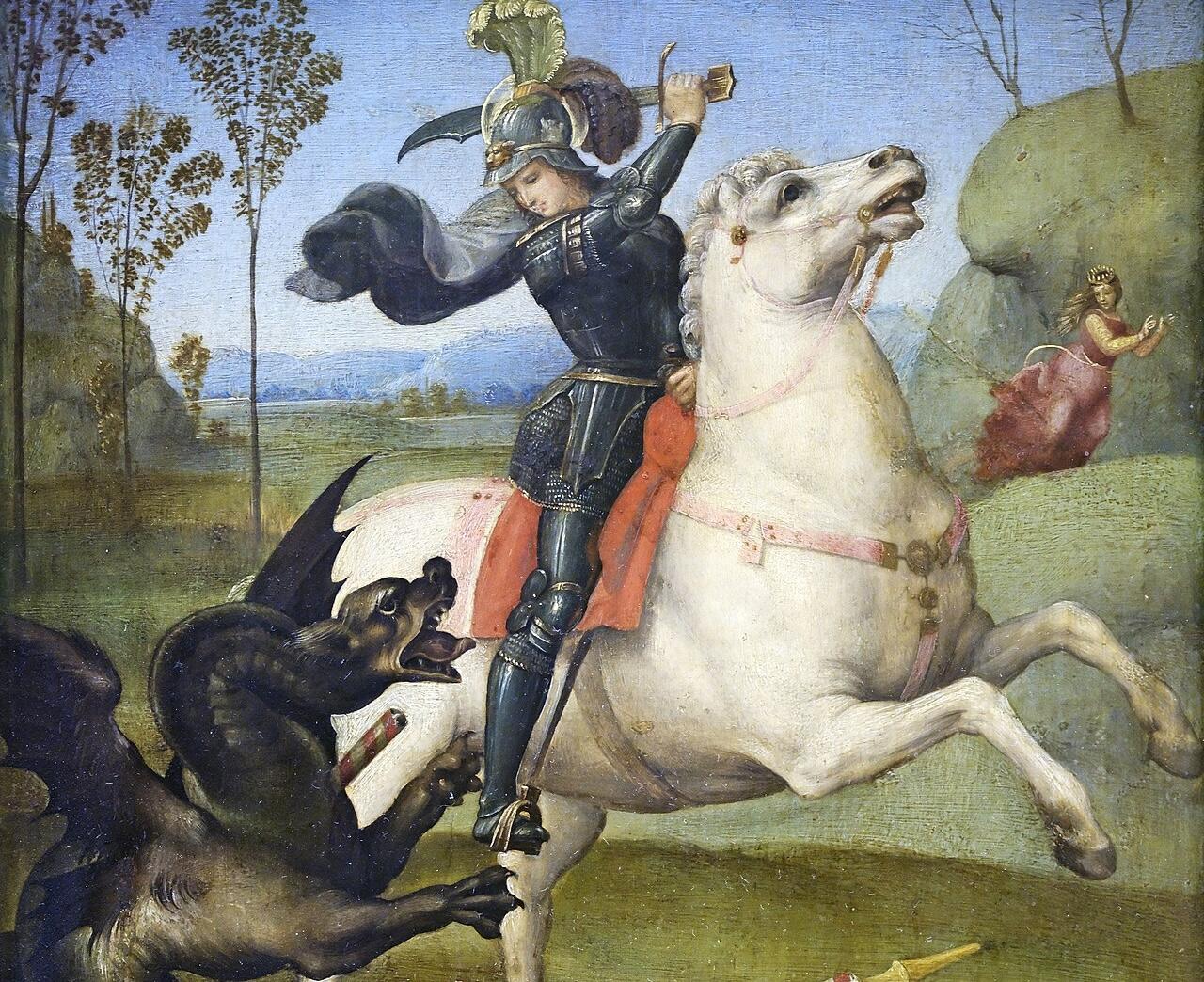
The famous story of the dragon was added to Saint George’s legend later.
The earliest reference to dragon-slaying is from the country of Georgia, in the 11th century.
From there, the addition spread into European legends – thus creating the image of George we know today, sitting on horseback, with his spear going through the dragon’s neck.
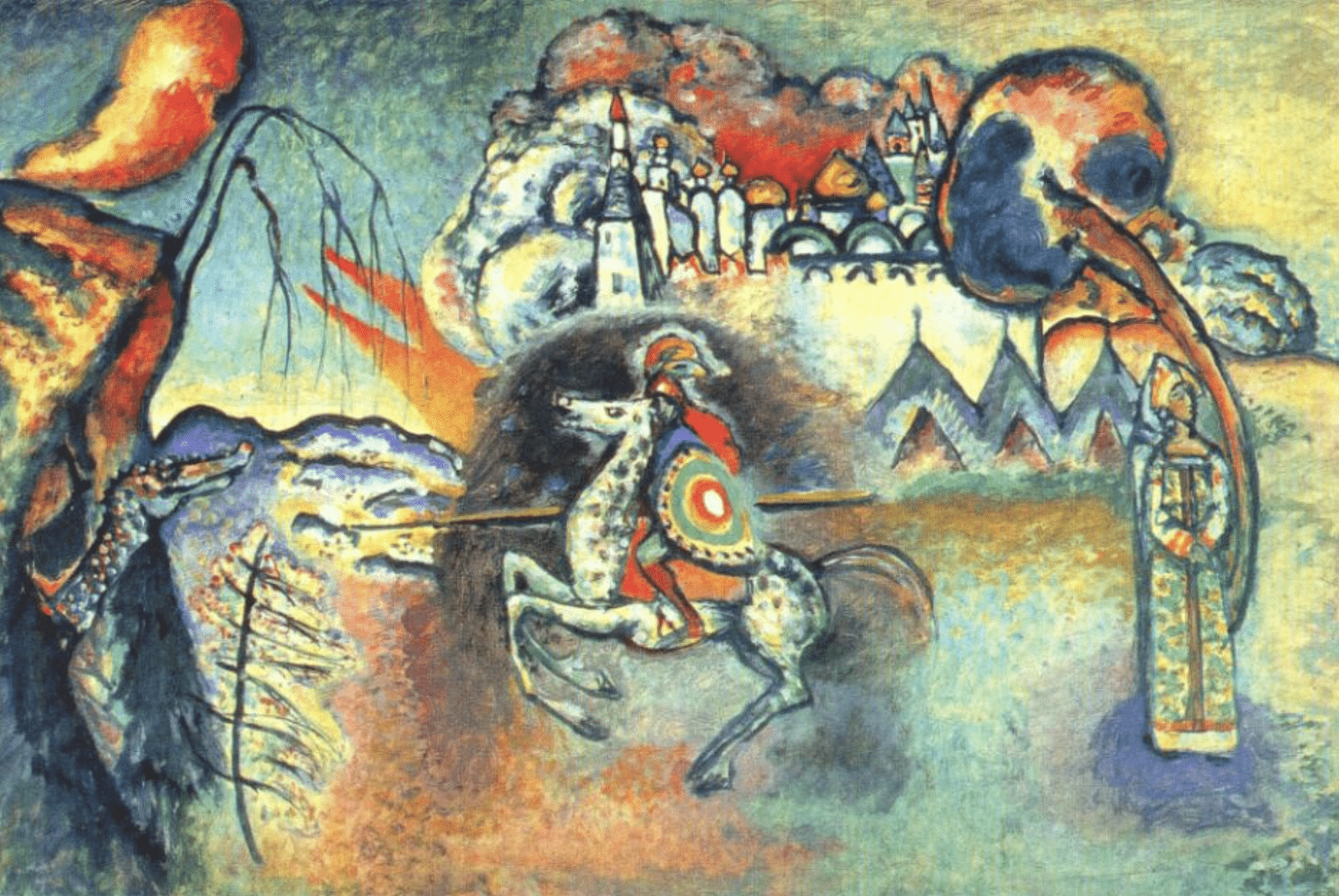
The longer version of that legend is as follows: George arrived in the city of Silene, in Libya, and found a dragon holding the residents hostage. To keep the dragon from ravaging the city, they would give it two sheep every day.
But when two daily sheep were no longer enough to placate the beast, the townsfolk started sending their own people to die in the dragon’s jaws. Eventually the king’s daughter was selected for sacrifice – but just then is when George showed up to slay the dragon and save the princess (and the city).
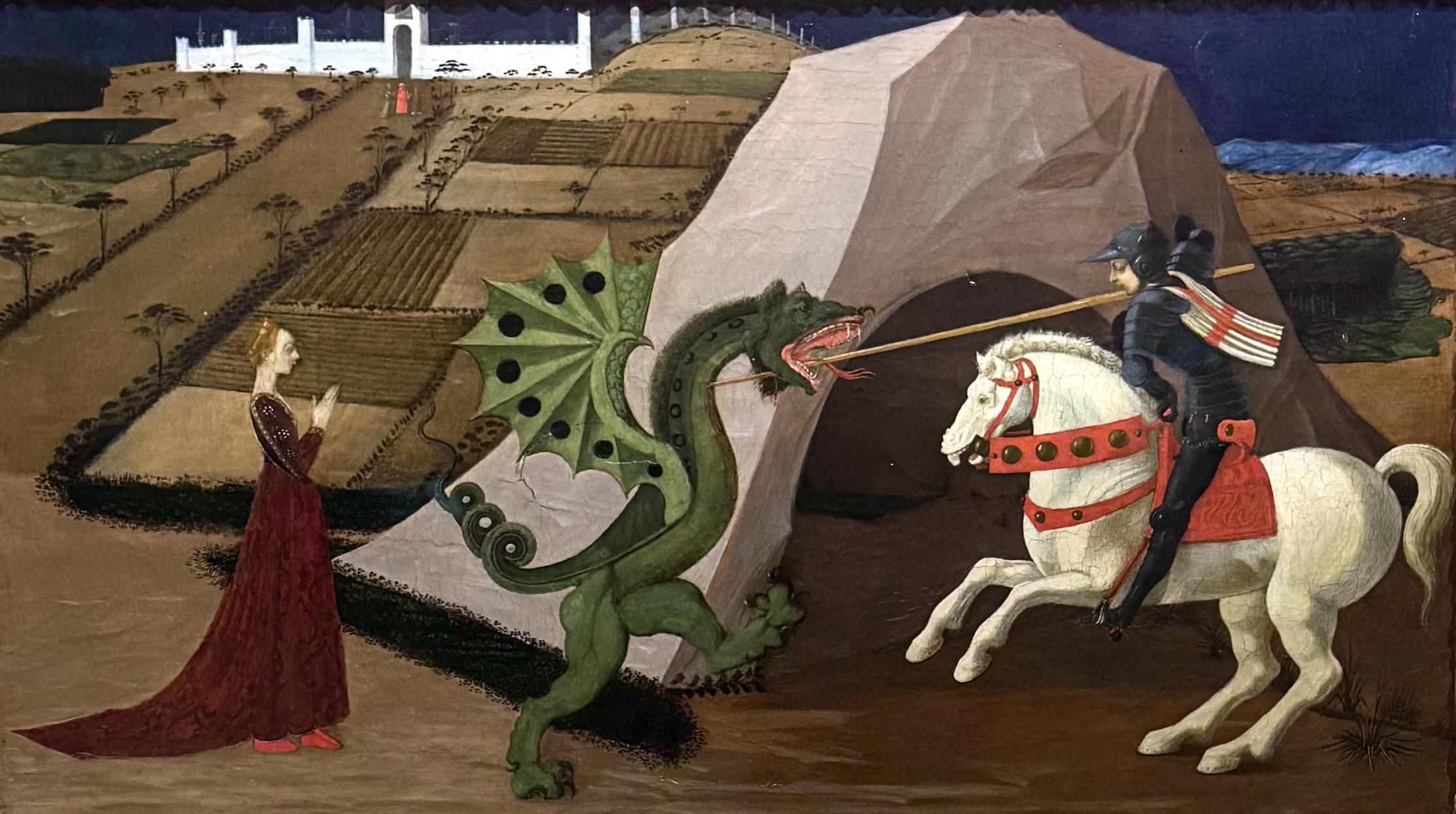
The king offered George some treasure as a reward, but George insisted that the treasure be used to feed the poor. The astonished townspeople converted to Christianity en masse.
Today, St George is the patron of knights, soldiers, archers, cavalry, riders and saddlers, and he helps those suffering from leprosy, plague and syphilis.
You might also invoke his name if bitten by a poisonous snake.
Veneration of Saint George
Saint George is venerated around the world.
The country of Georgia, in Eastern Europe, has exactly 365 Orthodox churches named after George.
According to legend, his body was divided after his death into 365 parts – one for each day of the year – which were spread to churches in every corner of the country.
Elsewhere, Saint George’s Cross – a red cross on a white background – is the flag of England, and part of the symbols forming the Union Jack.
The cruz de Sant Jordi also appears (twice) on the flag and the coat of arms of the city of Barcelona… as well as on the logo of Barça, the football club.
Here in Spain, Saint George is the patron of Catalonia, and also of the neighboring region of Aragón.

The city of Cáceres (in Extremadura) also venerates George as its patron. With a large and well-preserved Medieval city center, it’s a place you should definitely visit if you’re in the area.
(I started my bike tour of Extremadura there a couple of years ago.)
And every April 23, he’s celebrated here in Barcelona with “la diada de Sant Jordi” – which is the occasion for this article. So let’s get back to that.
Celebrating Sant Jordi in Catalonia
Some people refer to Saint Jordi as Catalan Valentine’s Day.
I’ve even heard conspiracy theorists suggest that Valentine’s Day was imported into Catalonia only to dilute local culture – something about the Corte Inglés department stores wanting to eliminate Catalan identity, for some reason.
Anyway, exchanging red roses with loved ones certainly gives it a V-Day-like vibe.
Booksellers come out and set up stalls on the central streets in Barcelona: specifically, La Rambla, Rambla de Catalunya, and Passeig de Gràcia.
There are usually authors who appear to sign their books (if you follow your favorite authors on Instagram or elsewhere, they’ll announce this in advance).
In other neighborhoods, the local bookstores bring books out onto the sidewalks, and roses are available everywhere.
If you live in a smaller city in Catalonia, there’s probably something going on as well.
This celebration has been happening since 1931, and April 23rd was chosen because it’s the date that both Shakespeare and Miguel de Cervantes (author of Don Quixote) died. Allegedly.
In 1995, UNESCO named April 23rd World Book Day, and the rest is history.
Mythbusters: Shakespeare and Cervantes
Both Shakespeare and Cervantes are recorded as dying on April 23rd, 1616.
But in reality, the idea that Shakespeare and Cervantes died on the same day is wrong.
According to the Folger Shakespeare Library, Spanish death certificates at the time listed the date of burial instead of the date of death. If Cervantes was buried on the 23rd, he probably died on 22 April. And Shakespeare died 11 days later, on May 3 – the discrepancy arising because of the difference between the Julian and Gregorian calendars.
(In other words, Shakespeare died on 23 April according to the Julian calendar, but that date corresponds to May 3 on the Gregorian – the calendar in use in Spain at the time, and commonly used today.)
If you want even deeper levels of conspiracy, you should know that the Catalan regional government once spent around 3 million euros producing documentaries that claim that both Cervantes and Shakespeare were Catalan.
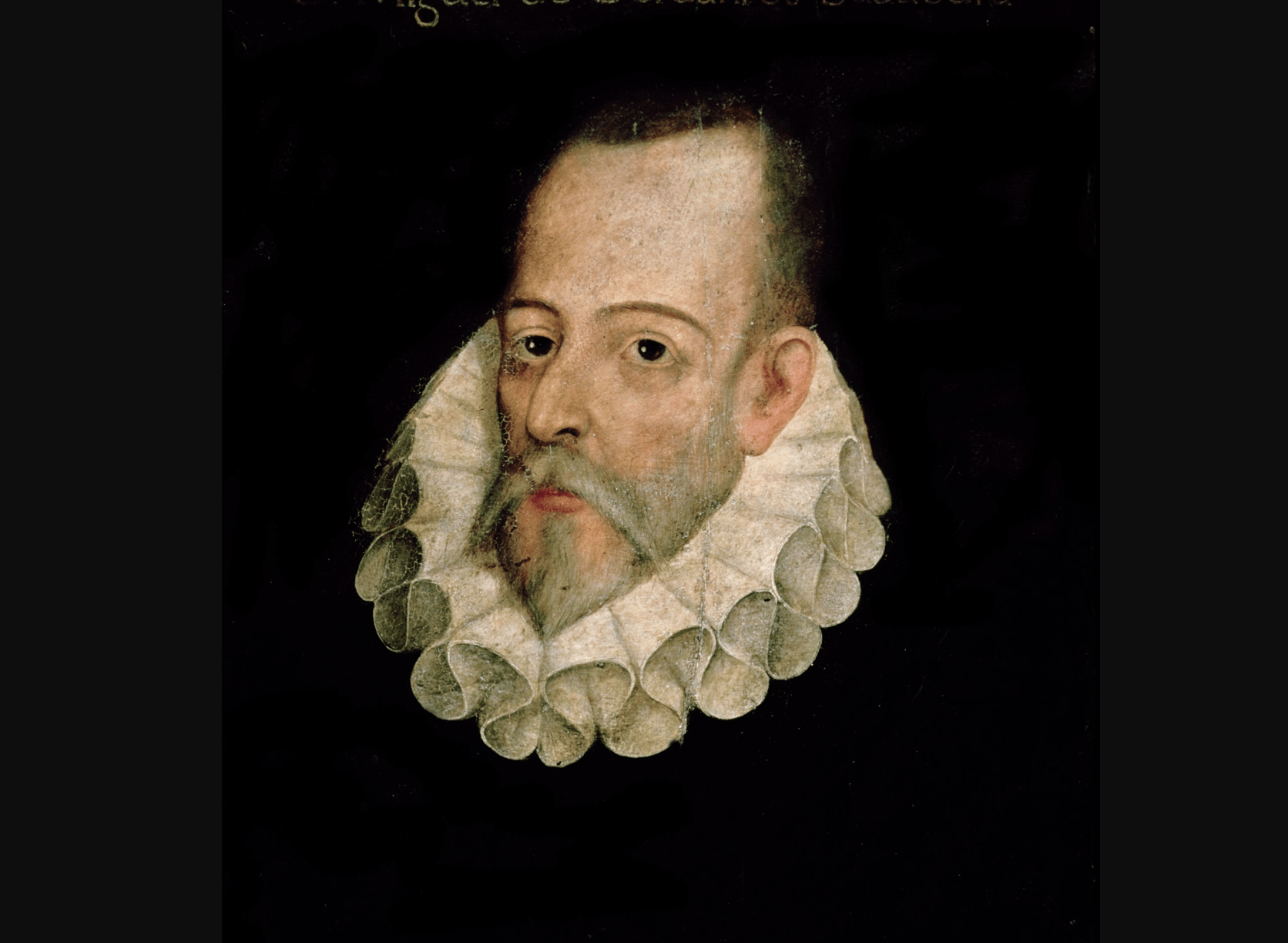
Yes, la Generalitat de Catalunya spent plenty of perfectly good money on this – even publicising the claim that both Shakespeare and Cervantes were the same man: a “Catalan” from Alicante named Joan Miquel Sirvent.
That’s big news, if true, because it would raise the number of famous Catalan authors from zero to one.
I’ve talked about famous Catalans on here before… there are a few. (Salvador Dalí and the singer Rosalía spring to mind.) But Shakespeare and Cervantes are only Catalan according to nutjob pseudo-historians.
However, that’s not the only conspiracy theory I’m unpacking today.
Was Catalan banned by the dictatorship?
Spanish Wikipedia says that Sant Jordi celebrations were banned by Franco in the mid-20th century.
I decided to independently confirm that before putting it in this article, and in doing so opened a virtual Pandora’s box of Catalan lies and partial truths. So here goes.
First, I found an article in El Debate that killed a myth I’d heard plenty of times – the myth that the Catalan language was “prohibited” during Franco’s dictatorship.
That turns out not to be the case – although I’d discourage you from debating your Catalan in-laws on this point. It’s widely “known” and repeated. But apparently not true.
El Debate points to an article in La Vanguardia from 1960, announcing a prize called Premio Sant Jordi for books written in Catalan – not exactly what you’d expect if the language was banned.
The same article mentions that between 1952 and 1974, almost 6000 books were published in Catalan. Several important Catalan writers began their careers. The language was taught in universities. Popular singers sang in Catalan. Etc.
(The government and administration didn’t use Catalan during the dictatorship – at least that appears to be true. And it’s quite possible that loudly speaking Catalan in public was a political statement that might get the attention of the police. The Objective has more to say – in Spanish – about the whole thing. But it looks like private use of Catalan wasn’t illegal or anything like it during el franquismo.)
What happened to Barça during el franquismo?
While we’e busting Catalan myths here, I had also heard, somewhere, that Futbol Club Barcelona was banned during the dictatorship.
That’s not true either.
There was, of course, pressure to remove the Catalan independence elements in Barça fandom, and again, the Catalan language was eliminated from official team bulletins.
But Barça survived and became symbolic of a sort of subtle resistance to Franco.
(Side note: in 1925, Barcelona was suspended from play for six months because fans had whistled derisively during the Spanish national anthem. That was during the dictatorship of Primo de Rivera, whose son went on to found the Spanish fascist movement. So there was a ban on Barça, briefly, under another of Spain’s many dictators.)
If you enjoy these topics, I wrote about Franco and the Civil War last year – that article’s got quite a bit of Spanish history. I’ll be following up with part II at some point, about the dictatorship itself. I’m sure the Catalans have plenty of legitimate reasons to complain about Franco.
There’s also more to say about how some Spanish people dislike their own national anthem – I talk about that in my article on symbols of Spain.
Sant Jordi without the masculinity
Last year, I noticed something odd about the Sant Jordi celebrations here in Barcelona: Saint George the man had mostly been erased from them.
There were stalls selling books, and roses, of course. There were little plush dragon toys on sale everywhere as well. But no images of Saint George.
Most of the official posters I’ve found from last year seem to bear this out: there are books, roses, and dragons. Cute dragons, sometimes reading. But virtually no Saint George.
Of course, I understand that “knight with impressive lance saves princess” isn’t a narrative we want young people to be absorbing, in these forward-thinking times.
And the violence! Couldn’t Saint George have invited the dragon to share a plant-based meal with him instead? They could have sat down and talked about the pressures they both felt to fit in with society’s expectations about heteronormative masculinity. About where their anger comes from.
Maybe, in that way, they could have set aside the whole toxic “slayer vs dragon” dynamic, and everyone would have been the better for it.
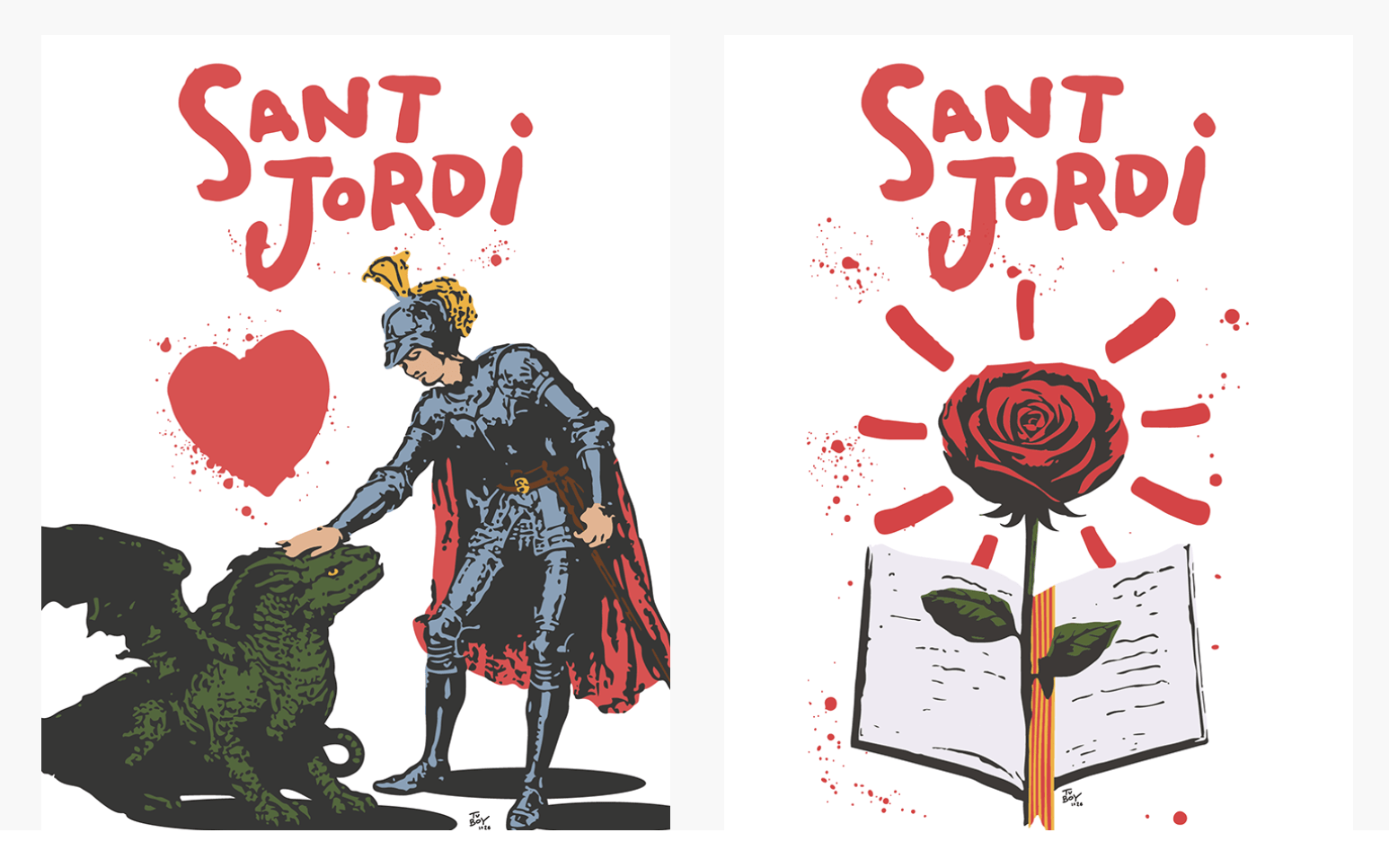
This year, the official posters here in Barcelona were done by an Italian graffiti artist known as TVBoy.
One depicts a book with a rose, one has a man kissing a woman in dragon pyjamas.
The final poster has Saint George petting the dragon on the head, with a large floating heart representing the obvious love between the two. It’s quite touching, but completely misses the point.
The true meaning of Saint George’s Day
I’ve recently learned that some people don’t always pick up on my obvious sarcasm.
So let me be clear here.
The point of the legend of Saint George is that we need strong, brave men to go out and defend civilization from the evils lurking outside the walls.
The point is that cowards without moral clarity will try to placate evil. Maybe they’ll sacrifice their sheep, or their neighbors, or even their children, to the dragon – or what it symbolizes.
Anything to maintain their comfortable lifestyle. After all, the dragon’s out there… not in here. And it’s asking to be placated.
Maybe this “diplomatic” strategy will work for awhile. But it’s not a solution. It’s just procrastination. And meanwhile, the dragon gets stronger with every day.
The point of going out and slaying the dragon is that good triumphs over evil, that order triumphs over chaos. And (for the hero) the point is that he’s transformed and born again in the process.
This is basic Joseph Campbell stuff. And timeless, as well.
Ignore the point at your own peril.
Yours,
Daniel AKA Mr Chorizo.
P.S. If you like this, you might also like my recent articles on Saint Ignatius of Loyola, or about Gaudí and Sagrada Familia, or about Golden Calves and God-Shaped Holes. And for more about Cervantes, who was Spanish (but not Catalan) check out the route of Don Quixote.
P.P.S. These days, the top article on the blog is Famous Spanish people, which I’d encourage you to check out. It’s got pop stars, actors, my brush with famous wangs, and much more.
P.P.P.S. Seriously, you can donate to the blog. It’ll help me afford coffee and sparkling water, at Barcelona prices. And also I’ll give you a shoutout, here or on the podcast. Thanks!

0 comments